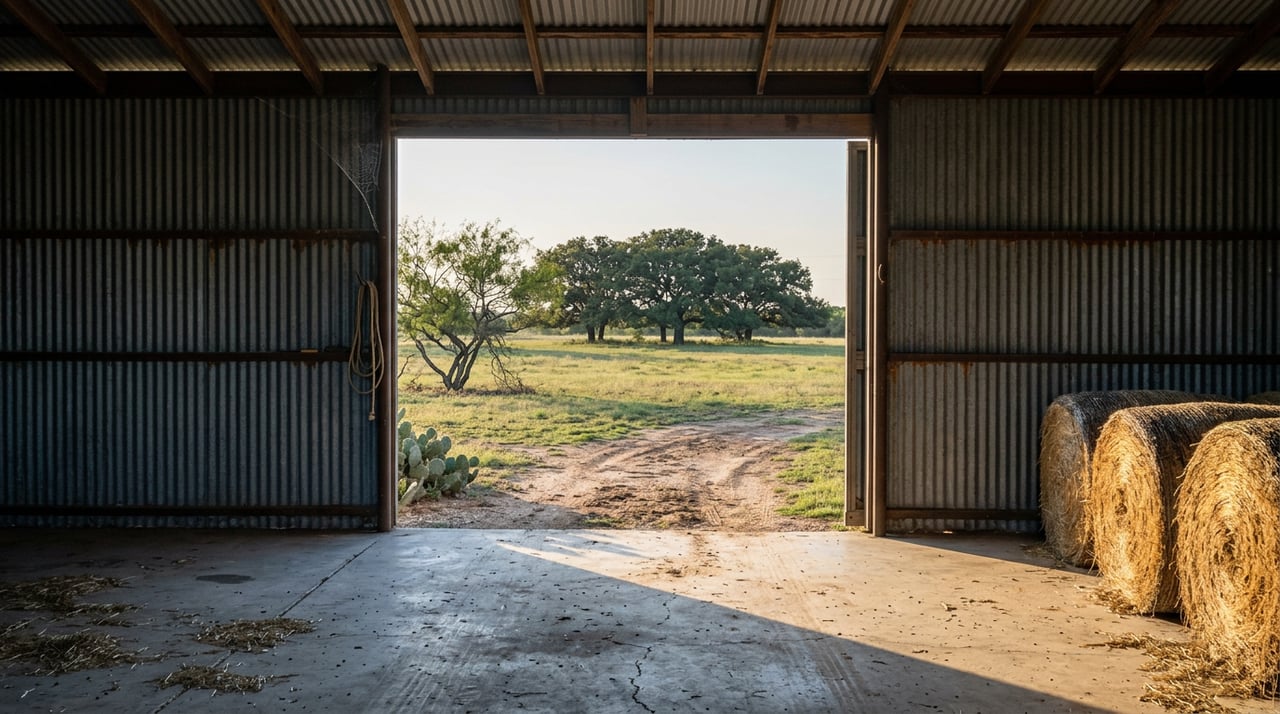
The tax bill looked too good to be true, and it was. A buyer closes on 40 acres outside Chappell Hill in October, the seller's cattle roll off the property the same week, and the new owner spends the winter planning a barn instead of worrying about paperwork. Then April arrives, the Washington County Appraisal District mails a notice, and the low agricultural valuation that made the deal pencil out is gone. Not reduced. Gone, with three years of back taxes and interest attached to the difference between what was paid and what would have been paid at full market value.
This is not a hypothetical built to scare anyone. It is how Texas ag valuation actually works, and it catches out-of-area ranch and horse property buyers more often than any inspection item on a Washington County property. The mechanism is simple once you see it, but almost nobody explains it before closing, because the seller's agent has no reason to and the buyer's excitement about the barn or the arena crowds it out.
The Valuation Is a Behavior, Not a Feature
Realtors and sellers talk about a property's ag exemption the way they talk about square footage, as if it were a fixed characteristic that transfers with the deed. It is not. Texas Tax Code Chapter 23 allows land devoted to agricultural, timber, or wildlife management use to be appraised on its productivity value rather than its market value, and that difference is usually what makes a working pasture in Washington County affordable to carry. But the valuation attaches to how the land is being used, not to who owns it. Every new owner has to file their own application with the Washington County Appraisal District, and the district does not renew it automatically just because the cows never left.
If the property already carried an ag valuation at closing and the qualifying use continues without a gap, the new owner typically picks up the valuation as soon as WCAD accepts the application. If the property was not previously in ag use, or if the use lapses during the ownership transition, Washington County's own rule requires a documented history of agricultural use for five of the preceding seven years before the land qualifies again. That is not a formality. It means a buyer who lets a pasture sit empty over a winter while deciding what to run on it can find themselves years away from requalifying, paying full market-value taxes in the meantime.
The filing window matters as much as the paperwork itself. Applications are due between January 1 and April 30 of the tax year, and Washington CAD's own guidance treats that date as the date, not a suggestion. A ranch that closes in November gives the new owner only a few months to get an application in before that first spring deadline. WCAD's field appraisers are also out in the county from August through March each year, in marked vehicles and carrying TDLR licenses, confirming whether the use on the ground matches what is on file. A buyer who closes in the fall and hasn't restocked the pasture by the time an appraiser drives past in January is exactly the kind of gap the district is set up to notice.
The Rollback Is the Part That Actually Costs Money
Losing the valuation is one problem. The rollback tax is the one that shows up as a real number on a real bill. Under current Texas law, when land that qualified for agricultural appraisal changes to a non-agricultural use, the owner at the time of the change owes the difference between what was paid under ag valuation and what would have been paid at market value, calculated for the three years before the change, plus interest at 5 percent per year. That three-year, 5 percent structure has been in place since House Bill 1743 took effect in 2019, replacing what had been a five-year, 7 percent penalty, so it is somewhat less punishing than it used to be. It is still not small. On a modest acreage with a meaningful gap between market and productivity value, the recalculated bill can run into five figures.
The trigger is not always dramatic. Fencing off a section for a personal yard, building a homesite where cattle used to graze, or simply letting the fields sit idle can all count as a change of use in the appraisal district's eyes. Carve-outs are proportional, so building a home on two acres of a 200-acre tract only triggers rollback on those two acres if the rest of the property stays in qualifying use and the paperwork with WCAD reflects the split correctly. That last part, getting the CAD paperwork to reflect the split, is where a lot of buyers assume the math will sort itself out and find out later that it does not.
| Milestone | Timing | Why it matters for a new owner |
|---|---|---|
| Ag valuation application window | January 1 to April 30 | New owner must file even if the prior owner had the valuation |
| WCAD field inspections | August through March | District confirms qualifying use is actually happening on site |
| Ag use history requirement | 5 of the preceding 7 years | Required if the land wasn't already ag valued at purchase |
| Rollback lookback period | 3 years, plus 5% annual interest | Owed by whoever owns the land when qualifying use changes |
The Fence You're Buying Might Only Be Doing Half the Job
The second surprise has nothing to do with taxes and everything to do with what a fence is legally for. Most buyers moving from suburban or urban property assume that a fence exists to keep other people's animals out. In rural Texas, the default rule is the opposite. Texas is what's known as an open range, or fence-out, state under the common law recognized by the Texas Supreme Court more than a century ago, and that rule is still codified today in Chapter 143 of the Texas Agriculture Code. Absent a local election that changes it, a livestock owner has no legal duty to keep their cattle off a neighbor's land, and the neighbor is the one responsible for fencing them out if that's what they want.
Counties can vote to reverse this through a local stock law election, closing the range for some or all species, and many counties across Texas have done exactly that in parts of their territory. Washington County is not one of the roughly twenty counties statutorily barred from ever closing the range for cattle, which means it is legally possible for some precincts to have passed a stock law decades ago. But there is no single, current, official state registry of which Texas counties or precincts have done so. The historical record lives in county commissioners court minutes, some dating back to the 1900s through the 1930s, and confirming status for a specific piece of land means calling the county clerk or sheriff's office, not searching a database.
There's one carve-out worth knowing regardless of local election history. Under state law, U.S. and state highways are automatically treated as closed range no matter what a county has or hasn't voted on, meaning livestock cannot legally roam onto those roads unattended. Farm-to-market roads do not get that automatic protection. With more than 40,000 miles of FM roads crossing Texas, including plenty that border Washington County acreage, an unfenced boundary along an FM road is open range by default unless a local stock law says otherwise.
A Short Checklist Before You Waive Anything
- Call the Washington County Appraisal District's agricultural assessment line before your option period ends and ask directly whether the parcel's ag or wildlife valuation is current, and what documentation supports it.
- If the land was not already ag valued, ask what portion of the five-of-seven-year use history you can actually verify, and price the carrying cost of full market-value taxes into your offer until that history is established.
- If you plan to keep livestock off, replace, or change the type of use on day one, ask your title company or a local attorney whether that change needs to be reflected in the CAD paperwork before closing to avoid a rollback trigger.
- Contact the county clerk or sheriff's office for the specific precinct to confirm whether a stock law has been passed for the species you plan to keep, rather than assuming a fenced pasture keeps out a neighbor's cattle.
- If any boundary runs along a farm-to-market road, budget for perimeter fencing as though the county is open range unless you get written confirmation otherwise.
Frequently Asked Questions
Does an ag exemption automatically carry over when I buy a property that already had one? Not automatically. The valuation follows continued qualifying use, and you have to file your own application with Washington CAD, typically by April 30 of the year following purchase, even if the previous owner's cattle are still grazing the land at closing.
If I only plan to build a home on part of a larger tract, does the whole property lose its ag valuation? Rollback is generally proportional to the acreage that changes use, so a homesite carved out of a larger qualifying tract should only trigger rollback on that carved-out portion, provided the rest of the land stays in qualifying use and the appraisal district's records reflect the split.
How do I find out if my specific road frontage is open range or closed range? There is no central state database. The most reliable path is contacting the Washington County clerk or sheriff's office, since the historical record of any stock law election lives in commissioners court minutes rather than a searchable public list.
None of this is a reason to walk away from ranch or equestrian acreage in Washington County. It is a reason to ask the right questions before the option period closes instead of after the tax notice arrives. If you're weighing a horse farm, a working ranch, or acreage anywhere between Brenham, Chappell Hill, and Burton, Lisa Marie Bricker works these details into every transaction from the first showing. Schedule a Consultation to talk through what a specific property's ag history and fence line actually mean for your ownership before you make an offer.